




Customers increasingly expect to pay by card wherever they do business. That applies whether they are buying a cup of coffee, paying a contractor, shopping online, visiting a professional office, or purchasing from a mobile business.
For owners researching how to accept credit card payments small business, the number of available options can initially seem complicated. Do you need a merchant account? Should you use a countertop terminal or POS system? Can you take payments directly from a phone? What about online transactions? And how much will accepting cards actually cost?
Fortunately, learning how to accept credit card payments small business owners can use successfully does not need to be difficult.
At its most basic level, you need a way to capture the customer’s payment information, a payment processor capable of securely processing the transaction, and a method of depositing approved funds into your business bank account.
The best setup depends on how and where your customers pay.
A restaurant may need integrated POS terminals. A contractor may need mobile credit card processing. An ecommerce company needs an online payment gateway. A professional service provider might use a virtual terminal for phone payments.
Understanding how to accept credit card payments small business owners need today therefore begins with choosing the correct payment channels rather than simply choosing a card reader.
This guide explains the entire process, from opening a merchant account to accepting in-person, online, mobile, and phone payments.
Why Small Businesses Should Accept Credit Card Payments
Cash is still useful, but relying exclusively on cash can create unnecessary friction for customers.
Consumers are accustomed to paying with:
- Credit cards
- Debit cards
- Contactless cards
- Smartphones
- Digital wallets
- Online checkout
- Recurring payments
Understanding how to accept credit card payments small business customers prefer can make purchasing easier and remove obstacles at checkout.
Card acceptance can also be valuable when customers make larger purchases. Someone who may not carry hundreds of dollars in cash can complete the transaction immediately using a card.
For businesses operating online, card payments are even more important because physical cash is usually not an option.
Knowing how to accept credit card payments small business owners can rely on also makes it possible to sell through multiple channels. A merchant might accept cards at a physical store while simultaneously taking payments through an ecommerce website and mobile devices.
That flexibility allows payment technology to adapt to the business rather than forcing the business into one payment method.
How Credit Card Payment Processing Works
Before deciding how to accept credit card payments small business, it helps to understand what happens when a customer actually pays.
The transaction may appear instantaneous at the checkout counter, but several organizations can be involved behind the scenes.
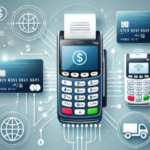
A typical payment includes:
- The customer
- The merchant
- The payment terminal, POS, website, or payment interface
- The payment processor
- The acquiring bank
- The card network
- The cardholder’s issuing bank
When a customer presents a card, the payment information is securely transmitted through the payment system.
The issuing bank determines whether the transaction should be approved or declined.
If approved, an authorization response travels back through the system to the merchant.
The entire process often occurs within seconds.
Later, approved transactions go through settlement and the merchant receives the funds according to the processor’s funding schedule.
Understanding this process makes how to accept credit card payments small business much easier to evaluate because you can separate the technology used at checkout from the financial infrastructure processing the transaction.
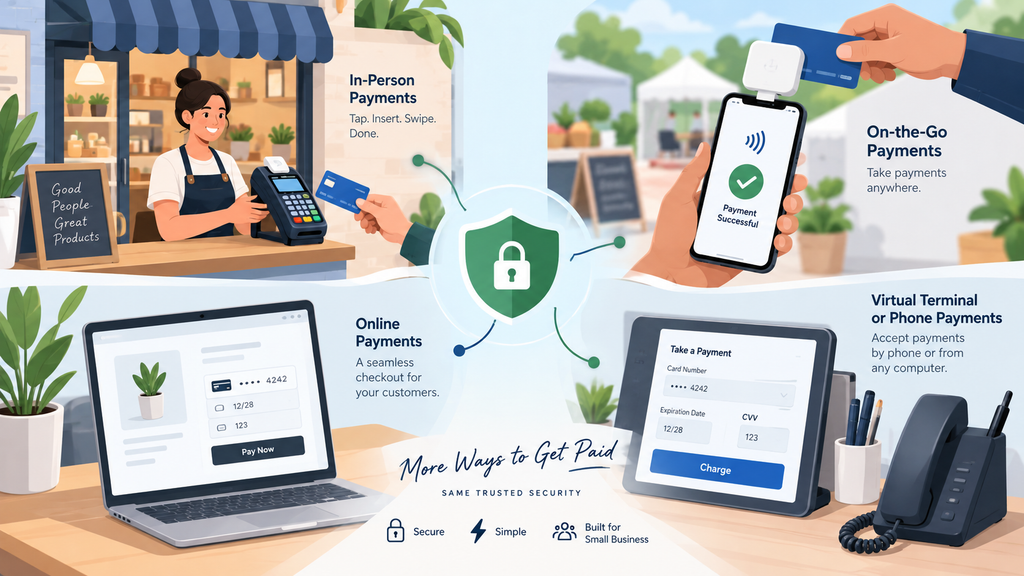
Step 1: Decide Where You Need to Accept Payments
The first decision when researching how to accept credit card payments small business is where customers will actually pay.
There are four major environments.
In Person
This includes:
- Retail stores
- Restaurants
- Salons
- Medical offices
- Professional offices
- Service counters
- Entertainment businesses
You will generally need a physical terminal, POS system, or compatible tap-to-pay device.
Online
Online businesses typically need:
- Ecommerce checkout
- Payment gateway
- Payment processor
- Secure website
- Shopping cart integration
On the Go
Mobile businesses may need to process payments wherever the customer is located.
Examples include:
- Contractors
- Landscapers
- Delivery businesses
- Mobile repair services
- Vendors
- Event businesses
Over the Phone
Some businesses take payments remotely when customers provide their card information by phone.
In these situations, a virtual terminal can allow authorized employees to securely enter payment details through a web-based interface.
A business may use one of these channels or all four.
Determining the channels you need is one of the most important steps in understanding how to accept credit card payments small business efficiently.
Step 2: Choose a Payment Processor
A payment processor helps route transactions through the electronic payment ecosystem.
When determining how to accept credit card payments small business, processor selection deserves careful consideration because the provider can influence:
- Transaction pricing
- Monthly fees
- Funding
- Equipment options
- Reporting
- Integrations
- Customer support
- Chargeback handling
- Payment security
- Contract terms
Do not choose a processor solely because it advertises a low percentage.
Ask about the entire cost structure.
The lowest advertised rate does not necessarily mean the lowest total processing expense.
Businesses learning how to accept credit card payments small business should compare how each processor’s pricing works with their actual transaction volume, average ticket size, and payment channels.
Step 3: Set Up a Merchant Account
A merchant account is part of the infrastructure that allows a business to accept card payments and receive settlement funds.
Depending on the payment provider, the merchant account may be established directly as part of the onboarding process or incorporated into a broader payment service.
For someone researching how to accept credit card payments small business, it is useful to distinguish between a merchant account and a standard business checking account.
They are not the same thing.
The merchant account facilitates card-payment processing and settlement. Funds are then deposited into the business’s designated bank account according to the provider’s funding schedule.
Businesses may be asked to provide information such as:
- Legal business name
- DBA name
- Tax ID
- Business address
- Owner information
- Bank information
- Estimated monthly volume
- Average transaction amount
- Products or services sold
- Website information
This process helps the provider understand the business and its transaction profile.
A merchant account is only one part of the larger payment ecosystem. For a deeper explanation of acquiring, authorization, settlement, processors, and merchant accounts, read our guide to merchant processing.
Businesses that need more than a basic card-processing account should also understand merchant services for small business, including payment equipment, gateways, POS systems, reporting, and funding.
Step 4: Choose Your Credit Card Equipment
Hardware is another major part of how to accept credit card payments small business owners should consider.
The correct equipment depends on how your company operates.
Countertop Credit Card Terminals
A traditional countertop terminal is often ideal for businesses that primarily take payments at one fixed checkout location.
Modern terminals may support:
- EMV chip cards
- Contactless cards
- Debit cards
- PIN entry
- Digital wallets
They are commonly used in retail stores, restaurants, offices, and service businesses.
POS Systems
A point-of-sale system does more than process payments.
Depending on the system, it may also provide:
- Product catalog management
- Inventory
- Employee access
- Sales reporting
- Customer management
- Receipt options
- Discounts
- Tax calculation
- Tip management
When researching how to accept credit card payments small business owners should decide whether they simply need payment acceptance or a more complete business-management system.
A POS can be valuable when payment processing needs to interact with other operations.
Mobile Card Readers
A mobile card reader can be useful for merchants who travel to customers.
A compatible reader connects to a smartphone or tablet and transforms it into a payment acceptance device.
This approach makes how to accept credit card payments small business operations more flexible because employees are no longer limited to a traditional checkout counter.
Mobile processing can be particularly useful for:
- Contractors
- Home-service businesses
- Market vendors
- Food businesses
- Event merchants
- Delivery services
Tap to Pay
Some modern payment solutions allow compatible smartphones to accept contactless payments without requiring a traditional standalone terminal.
Customers can potentially tap a compatible card, smartphone, or digital wallet against the merchant’s device.
For very small or mobile businesses researching how to accept credit card payments small business, tap-to-pay technology can reduce the amount of equipment they need to carry.
The exact capabilities depend on the provider and device being used.
Step 5: Learn How to Accept Credit Card Payments In Person
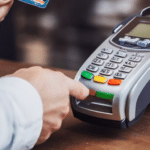
For many businesses, the easiest answer to how to accept credit card payments small business is through a card-present payment terminal.
A customer typically:
- Inserts an EMV card
- Taps a contactless card or device
- Follows terminal instructions
- Confirms the purchase
- Receives a receipt
The terminal communicates with the payment processor, and the transaction is approved or declined.
Modern in-person payment systems should generally support both chip and contactless technology.
Customers may want to pay using:
- Physical credit cards
- Debit cards
- Apple Pay
- Google Pay
- Other compatible digital wallets
Businesses evaluating how to accept credit card payments small business should therefore check which payment methods their equipment supports before committing to a solution.
Step 6: Learn How to Accept Credit Card Payments Online
An ecommerce business has different requirements.
Instead of presenting a physical card, the customer enters payment information through an online checkout.
Understanding how to accept credit card payments small business websites can process requires three major components:
Ecommerce Platform
This manages your store, products, checkout, and orders.
Payment Gateway
The gateway helps securely transmit payment information from the website into the processing system.
Payment Processor
The processor routes the transaction through the necessary financial networks.
Many modern platforms integrate these pieces closely enough that the customer never notices the underlying complexity.
For merchants investigating how to accept credit card payments small business ecommerce sites should prioritize integrations, security, checkout experience, and total processing costs.
An unnecessarily complicated checkout can increase abandoned carts.
Payment acceptance should be easy for the customer even if the infrastructure behind it is sophisticated.
Step 7: Accept Credit Cards From a Mobile Device
Mobile payments have made how to accept credit card payments small business much more flexible than it was in the past.
Businesses are no longer necessarily tied to a cash register.
A mobile device can potentially become part of the merchant’s payment system.
This can be especially useful when employees perform services at the customer’s location.
Instead of sending an invoice and waiting for payment, a business may be able to complete the transaction immediately.
When determining how to accept credit card payments small business owners should consider whether mobile processing would improve:
- Cash flow
- Customer convenience
- Employee efficiency
- Payment collection
- Transaction tracking
For businesses that operate outside a traditional storefront, mobile processing may become the primary payment method rather than a secondary option.
Step 8: Accept Credit Card Payments Over the Phone
Some businesses need to accept payments when neither the customer nor the physical card is present.
This is another important aspect of how to accept credit card payments small business operators frequently encounter.
A virtual terminal can allow an authorized employee to enter payment details through a secure browser-based interface.
Businesses that may use virtual terminals include:
- Professional service firms
- Contractors
- Repair businesses
- Medical offices
- Reservation-based companies
- B2B merchants
Card-not-present transactions can have different pricing and risk characteristics from card-present payments.
Businesses deciding how to accept credit card payments small business by phone should therefore understand both the cost and security implications before manually entering customer card information.
Step 9: Understand Credit Card Processing Fees
Accepting cards comes with processing costs.
For anyone learning how to accept credit card payments small business, understanding those expenses before choosing a provider can prevent surprises later.
Payment costs can potentially include:
- Interchange
- Network fees
- Processor markup
- Transaction charges
- Monthly fees
- Gateway fees
- Equipment expenses
- PCI-related fees
- Chargeback fees
The advertised percentage is only one piece of the total cost.
Two processors advertising similar rates could produce different monthly bills because of differences in transaction fees, monthly charges, equipment costs, and markup.
Businesses researching how to accept credit card payments small business should calculate their effective processing cost rather than focusing only on one rate:
If you want to understand exactly where those costs come from, our complete guide to credit card processing fees for small business breaks down interchange, processor markup, transaction charges, equipment costs, effective rates, and other common expenses.
Step 10: Keep Credit Card Payments Secure
Security should be part of every decision concerning how to accept credit card payments small business.
Payment information is sensitive, and businesses should use appropriate technology and providers to protect it.
Important practices can include:
- Using secure payment equipment
- Keeping systems updated
- Restricting employee access
- Using strong passwords
- Avoiding unnecessary storage of card information
- Maintaining secure ecommerce systems
- Working with reputable payment providers
- Following applicable PCI DSS requirements
Small businesses should not assume security standards apply only to large companies.
The PCI Security Standards Council provides payment security resources for small merchants to help businesses understand payment-data risks and the basic steps involved in protecting card informa
For businesses determining how to accept credit card payments small business, security should be evaluated at the same time as pricing and equipment not after the payment system has already been installed.
Step 11: Understand How Funding Works
Making a sale does not necessarily mean the money instantly appears in your bank account.
Funding is an important part of how to accept credit card payments small business owners sometimes overlook.
After transactions are approved, they go through settlement.
The processor then deposits eligible funds into the merchant’s designated bank account according to its funding schedule.
Ask a potential processor:
- What is the standard funding timeframe?
- Are weekends handled differently?
- Are there cutoff times?
- Are faster funding options available?
- What could delay a deposit?
- How are refunds deducted?
- How are chargebacks handled?
Cash flow matters to small businesses.
Understanding funding should therefore be part of evaluating how to accept credit card payments small business, not simply an afterthought once the account is operational.
Step 12: Decide Whether You Need Integrated Payments
Payment integration can make operations much easier.
A merchant considering how to accept credit card payments small business may want payments connected directly to:
- POS software
- Ecommerce systems
- Inventory
- Accounting
- Customer management
- Appointment software
- Recurring billing
- Reporting systems
Without integration, employees may need to manually enter information into several systems.
That can consume time and increase the possibility of mistakes.
An integrated solution can automatically connect the transaction with the rest of the business workflow.
For businesses processing a large number of transactions, integration can be just as important as the payment rate when deciding how to accept credit card payments small business effectively.
Step 13: Consider the Customer Checkout Experience
Payment processing is not only a back-office function.
It is part of the customer experience.
When deciding how to accept credit card payments small business, consider what your customer sees and experiences during checkout.
A good payment experience should be:
- Fast
- Simple
- Familiar
- Secure
- Transparent
Customers should not need unnecessary steps to complete a purchase.
In a retail environment, slow terminals can cause lines.
Online, a confusing checkout can lead customers to abandon their carts.
For mobile businesses, forcing customers to wait for an invoice when payment could be completed immediately creates unnecessary friction.
The best approach to how to accept credit card payments small business is one that works efficiently for both the merchant and customer.
Step 14: Decide Which Payment Types You Need
Credit cards are not the only electronic payments customers use.
A complete strategy for how to accept credit card payments small business should consider which additional methods are appropriate.
These could include:
- Debit cards
- Contactless payments
- Digital wallets
- Mobile payments
- Online payments
- Recurring payments
- ACH
- Invoices
You do not necessarily need every payment method available.
The goal is to support the payment options your customers actually use.
A retail business may prioritize contactless cards and digital wallets.
A subscription-based company may care more about recurring payments.
A contractor may need mobile card acceptance and invoicing.
Understanding customer behavior helps determine how to accept credit card payments small business without paying for unnecessary technology.
Step 15: Compare Processors Carefully
Once you understand your payment requirements, compare providers.
Businesses researching how to accept credit card payments small business should look beyond advertising and ask detailed questions.
Compare:
Pricing
What does each transaction cost?
Are there monthly charges?
What additional fees apply?
Equipment
Do you purchase, lease, rent, or receive equipment?
Contract
Is there a long-term agreement?
What happens if you cancel?
Funding
How quickly will transactions normally reach your bank account?
Support
Can you reach someone when there is a payment problem?
Integrations
Does the system work with your existing business technology?
Security
What security tools and practices are supported?
Reporting
Can you easily review transactions, deposits, refunds, and fees?
The right answer to how to accept credit card payments small business is not necessarily the processor with the lowest advertised rate.
If you are ready to compare providers, our guide on how to choose a credit card processor walks through the fees, contracts, equipment, support, and other factors worth checking before you sign.
The entire payment relationship matters.
How to Accept Credit Card Payments Small Business Owners Can Scale With
Your payment system should work today without becoming a limitation tomorrow.
When first learning how to accept credit card payments small business, owners sometimes choose the simplest possible solution without considering future growth.
That may be perfectly reasonable for a new business.
However, consider whether the system can eventually support:
- Additional terminals
- Additional employees
- Multiple locations
- Ecommerce
- Mobile payments
- Increased transaction volume
- More detailed reporting
- POS integrations
- Recurring billing
Switching payment infrastructure later can require time, new equipment, employee training, and integrations.
A scalable approach to how to accept credit card payments small business can therefore save operational work as the company grows.
How to Accept Credit Card Payments Small Business Owners Can Afford
Convenience matters, but so does cost.
A business may happily accept cards while quietly spending thousands of dollars every year on payment processing.
For that reason, researching how to accept credit card payments small business should include an evaluation of who ultimately absorbs those processing expenses.
Traditional processing generally means the merchant pays processing costs from its revenue.
Other pricing structures may allow eligible businesses to offset some or potentially most of those costs when properly implemented.
The best model depends on:
- Average transaction size
- Card volume
- Customer expectations
- Business type
- Payment channels
- Applicable rules and regulations
For some businesses, reducing the processing rate may be enough.
For others, changing the pricing model can have a much larger financial impact.
Can a Small Business Accept Credit Cards Without Absorbing All the Processing Costs?
This is an increasingly important question when considering how to accept credit card payments small business.
Card processing involves real costs, but that does not always mean the merchant must absorb those costs using the same traditional model.
Programs such as appropriately structured cash discount or dual-pricing arrangements may change how eligible businesses handle processing expenses.
The specific setup must account for applicable laws, card-network requirements, business type, and customer communication.
Merchants should therefore work with a payment provider that understands how the program should be structured rather than simply adding an arbitrary fee at checkout.
Businesses interested in accepting cards while reducing the amount of processing expense they absorb can learn more about how free credit card processing works and whether this type of program fits their business.
For someone researching how to accept credit card payments small business, comparing traditional processing with alternative pricing models can provide a much clearer understanding of the options available.
Common Mistakes When Setting Up Credit Card Payments
Learning how to accept credit card payments small business also means knowing what to avoid.
Choosing Based Only on the Advertised Rate
A low headline rate tells you very little about total cost.
Review the complete fee structure.
Signing an Equipment Lease Without Checking the Total Cost
A low monthly payment can become expensive when multiplied across a long contract.
Understand whether you are purchasing or leasing equipment.
Ignoring Contract Terms
Check:
- Contract duration
- Cancellation terms
- Renewal provisions
- Early termination fees
Ignoring Security
Payment security should never be postponed.
Use properly configured equipment and trusted providers from the beginning.
Buying More Technology Than You Need
A one-person mobile service business probably does not need the same infrastructure as a multi-location restaurant chain.
Match the system to your actual operation.
Failing to Review Processing Statements
Even after determining how to accept credit card payments small business, continue monitoring costs.
Your processing arrangement should evolve as your company changes.
How Much Does It Cost to Start Accepting Credit Cards?
There is no universal startup cost.
The cost of how to accept credit card payments small business depends on the provider, equipment, software, and payment channels involved.
Possible expenses include:
- Terminal purchase
- POS hardware
- Mobile card reader
- Gateway fees
- Software fees
- Monthly processing fees
- Transaction charges
- Setup costs
Some solutions have relatively low upfront equipment costs but higher transaction pricing.
Others require more initial investment but provide a different long-term cost structure.
Do not evaluate startup costs separately from ongoing processing expenses.
A free card reader does not necessarily mean inexpensive payment processing.
Likewise, paying for quality equipment upfront may be reasonable if the long-term economics are better.
The best way to evaluate how to accept credit card payments small business is to estimate the total cost over a meaningful period rather than focusing only on the first month.
How to Accept Credit Card Payments Small Business: A Simple Checklist
If all of this feels complicated, use this checklist.
To determine how to accept credit card payments small business, start with these questions:
- Where will customers pay?
- Will I accept payments in person?
- Do I need ecommerce payments?
- Do employees need mobile payments?
- Will I take payments over the phone?
- What is my estimated monthly card volume?
- What is my average transaction size?
- Do I need a POS system?
- What equipment will I need?
- What does the processor charge?
- Are there monthly or additional fees?
- How quickly will I receive funds?
- What security requirements apply?
- Does the system integrate with my software?
- Do I want to explore ways to reduce the processing expense I absorb?
Answering these questions makes how to accept credit card payments small business much easier to approach.
Choosing a Complete Credit Card Processing Solution
At this stage, you know there is much more involved than simply buying a card reader.
Understanding how to accept credit card payments small business requires considering the complete system.
That includes:
- Merchant account
- Processor
- Equipment
- POS
- Gateway
- Security
- Funding
- Integrations
- Pricing
- Support
A strong payment solution should make transactions easier rather than adding complexity to daily operations.
If you are comparing these elements together, our complete guide to credit card processing for small business explains processors, equipment, pricing models, security, payment technology, and other factors to consider before choosing a solution.
How Tap Simple Helps Small Businesses Accept Card Payments
Learning how to accept credit card payments small business is ultimately about finding a system that fits the way your company operates.
A retail shop may need reliable countertop payment equipment.
A restaurant may require a complete POS environment.
A contractor may benefit from mobile payment capability.
An online merchant needs ecommerce processing.
And a business concerned about processing expenses may want to evaluate pricing models designed to reduce the amount of those costs it absorbs.
Tap Simple helps businesses evaluate payment processing based on their actual needs rather than forcing every merchant into the same setup.
That can include looking at:
- Processing volume
- Transaction size
- Business type
- Payment channels
- Equipment needs
- Current processing costs
- Customer experience
A personalized approach to how to accept credit card payments small business can help merchants choose technology that supports both day-to-day operations and longer-term growth.
How to Accept Credit Card Payments Small Business Owners Can Rely On
The technology behind payments may be complex, but the decision does not need to be.
If you are researching how to accept credit card payments small business, start by identifying where your customers pay.
Then determine what payment technology you need.
Choose a processor.
Understand the pricing.
Select appropriate equipment.
Protect customer payment information.
Review funding.
Consider integrations.
And make sure the system can grow with your business.
Most importantly, do not treat how to accept credit card payments small business as a decision based solely on transaction rates.
The best payment setup should balance:
- Cost
- Reliability
- Security
- Convenience
- Customer experience
- Technology
- Support
- Flexibility
Small businesses now have more ways to accept electronic payments than ever before.
The right combination can allow customers to pay at the counter, online, over the phone, or wherever your employees do business.
Once you understand how to accept credit card payments small business, you can evaluate those options with much more confidence-and choose a processing system that supports your business instead of simply adding another expense.


