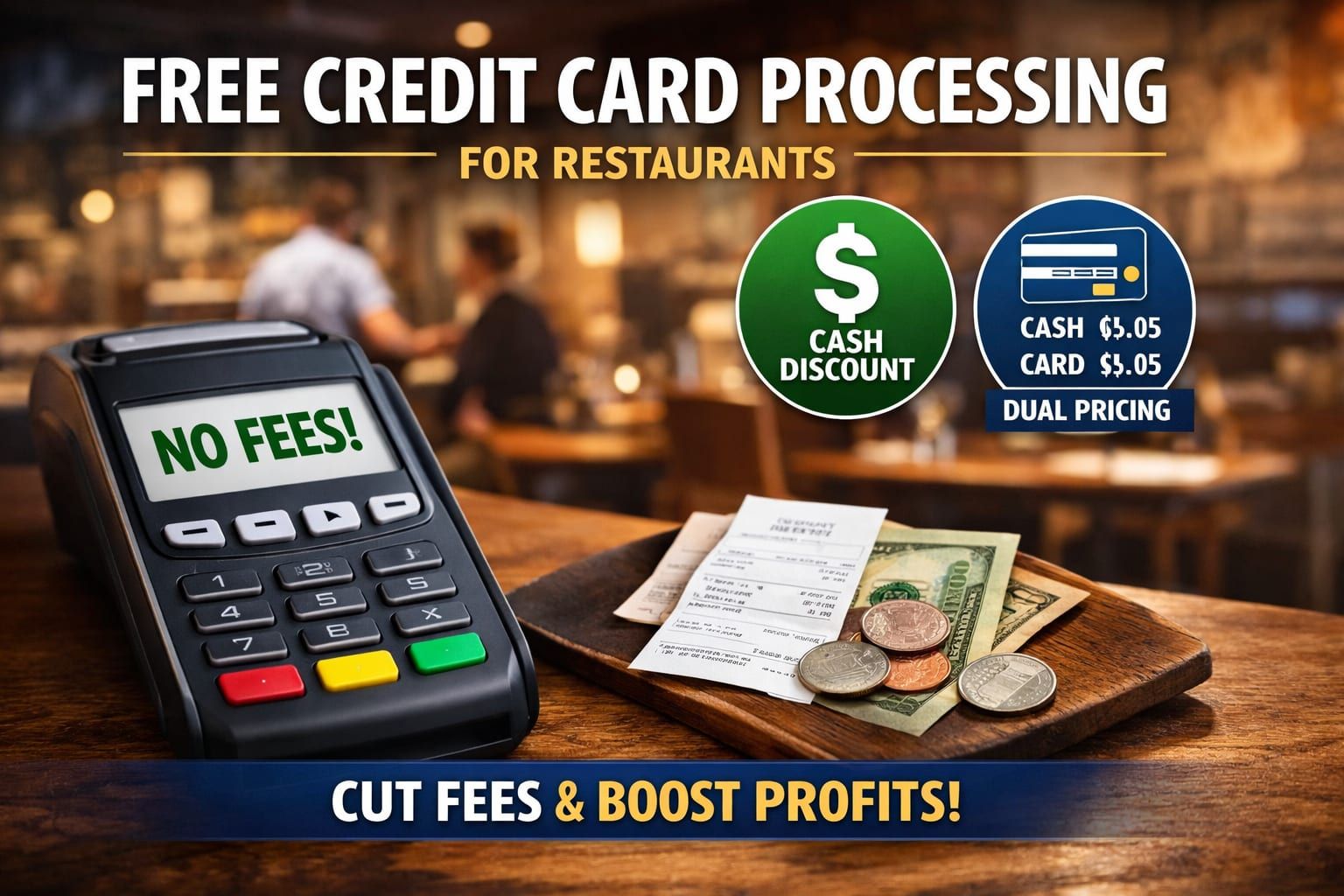
Free credit card processing for restaurants is one of the fastest-growing trends in the industry—and for good reason.
For years, restaurant owners have accepted payment processing fees as a fixed cost of doing business. But today, that model is changing. With the right setup, it’s now possible to significantly reduce—or even eliminate—those costs altogether.
This guide explains how free credit card processing for restaurants works, what options are available, and how to implement it without negatively impacting your customers or operations.
In a typical restaurant, payment processing fees can easily become one of the largest ongoing expenses. While they may seem small on a per-transaction basis, they scale directly with your revenue. The more you sell, the more you pay. Over time, this creates a situation where your success actually increases your costs.
That’s why more restaurant owners are starting to rethink how payments are handled. Instead of accepting these fees as unavoidable, they are looking for ways to regain control. Free credit card processing for restaurants offers a different approach—one that shifts the burden of fees away from the business and into a more flexible pricing structure.
This shift is not just about saving money. It’s about creating a more predictable and sustainable financial model. When you reduce your dependency on traditional processing structures, you gain better visibility into your costs and can make more informed decisions about pricing, operations, and growth.
Another important factor driving this trend is customer behavior. Today’s diners are already accustomed to price differences based on payment methods in other industries. When implemented clearly and transparently, free credit card processing for restaurants can feel like a natural extension of that experience rather than a disruption.
From a practical standpoint, this approach allows restaurants to maintain their margins without constantly adjusting menu prices to account for rising fees. Instead of increasing prices across the board, businesses can apply more targeted strategies that align with how customers choose to pay.
What Is Free Credit Card Processing?
Free credit card processing for restaurants doesn’t mean transactions are actually free—it means the cost is no longer absorbed by the business.
Instead, restaurants use pricing strategies that shift or offset processing fees, allowing them to keep more of their revenue.
The two most common models are:
Cash discounting
Dual pricing
Both approaches are designed to give restaurant owners more control over their payment costs while maintaining a smooth customer experience.
At its core, free credit card processing for restaurants is about transparency and control. Rather than hiding fees within your pricing or absorbing them silently, you create a system where costs are clearly structured and easier to manage.
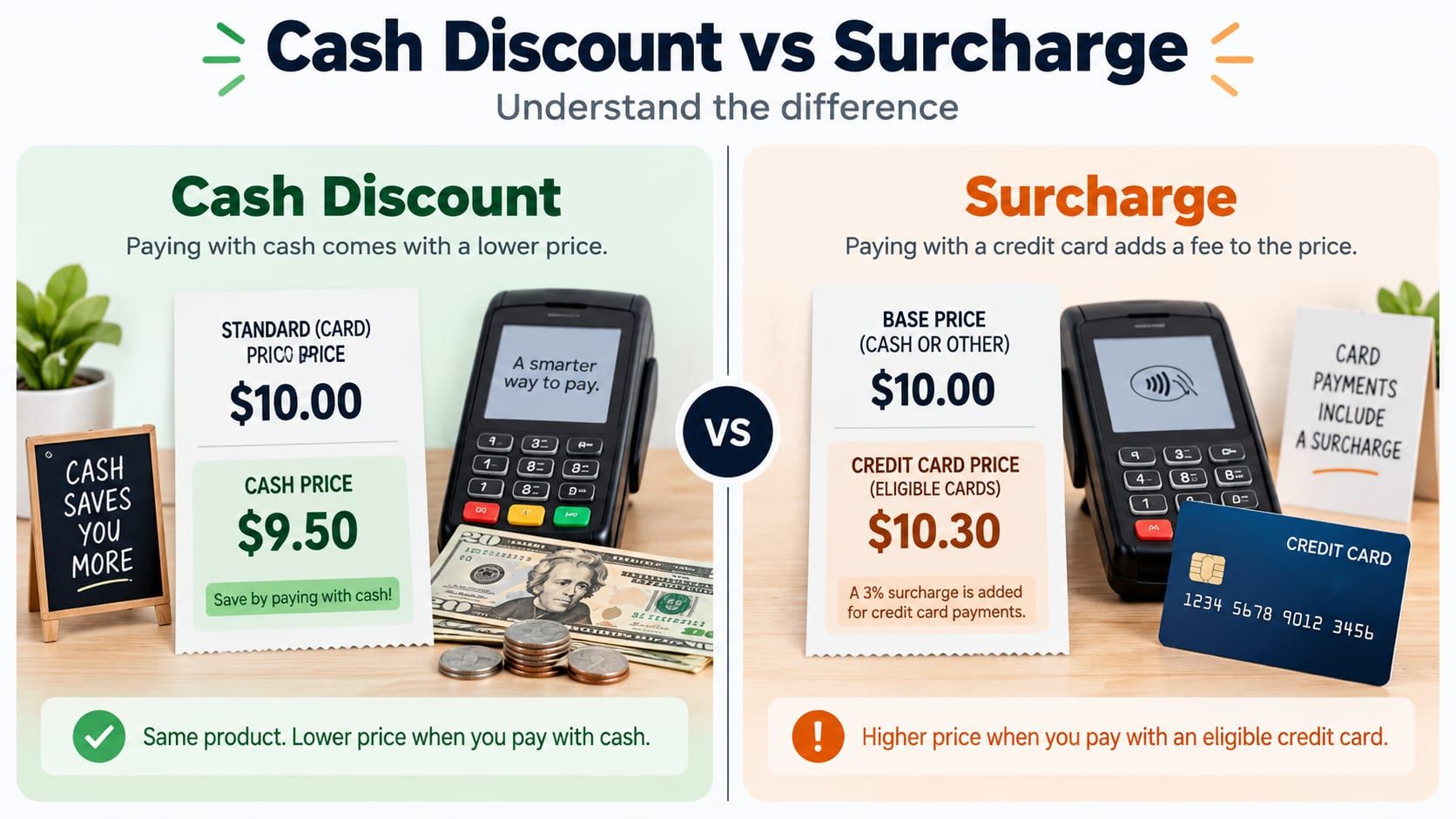
With cash discounting, customers who pay with cash receive a lower price, effectively rewarding them for choosing a lower-cost payment method. With dual pricing, both cash and card prices are displayed upfront, giving customers full visibility into how pricing works.
These models not only reduce costs but also simplify financial planning. Instead of trying to predict fluctuating processing fees each month, you create a more stable and predictable system that aligns with your actual transaction patterns.
For many restaurant owners, this represents a major shift in mindset. Payment processing is no longer just a backend function—it becomes a strategic part of how the business operates.
For a full overview, see our guide on restaurant payment processing.
How It Works
At its core, free credit card processing for restaurants is about changing how fees are handled, not eliminating them entirely.
Here’s how it typically works:
- A small adjustment is made to menu pricing
- Customers who pay with cards cover the processing cost
- Customers who pay with cash receive a discount
This creates a system where the restaurant no longer absorbs the fees directly.
For example, instead of paying 2.5% on every transaction, that cost is built into the pricing structure. Over time, this can lead to significant savings.
What makes this approach effective is that it aligns your pricing with real transaction behavior. Rather than applying a blanket increase to all customers, you are structuring your pricing in a way that reflects how payments are actually made. This creates a more balanced system where costs are distributed more efficiently.
It also simplifies long-term planning. Instead of dealing with fluctuating processing fees that vary month to month, you create a more predictable cost structure. This makes it easier to forecast expenses, manage margins, and make pricing decisions with confidence.
Another important advantage is operational simplicity. Once the system is set up correctly within your POS, the process runs automatically. Your staff doesn’t need to manually calculate anything, and customers experience a smooth checkout process without delays or confusion.
Cash Discount vs Dual Pricing
Understanding the difference between these two models is key.
Cash Discounting
- Menu prices reflect card pricing
- Cash customers receive a discount
- Simple to implement
Dual Pricing
- Two prices are displayed (cash vs card)
- More transparent for customers
- Increasingly popular in modern POS systems
Both models achieve the same goal: reducing restaurant payment processing fees.
The choice between these options often depends on how you want to present pricing to your customers. Some restaurants prefer the simplicity of cash discounting, while others value the transparency that comes with dual pricing.
In both cases, clear communication is essential. When customers understand how pricing works, the experience remains smooth and predictable. Most importantly, these models allow restaurants to reduce costs without negatively impacting service or satisfaction.
See how restaurant payment processing feeswork in detail.
Why Restaurants Are Switching
More restaurant owners are adopting free credit card processing for restaurants because it directly improves profitability.
Key benefits include:
- Reduced or eliminated processing fees
- Better cost control
- Increased pricing transparency
- Improved long-term margins
For high-volume restaurants, the difference can be substantial.
Over the course of a year, even a small reduction in processing costs can translate into thousands of dollars in savings. This is especially important in an industry where margins are often tight and every percentage point matters.
Beyond the financial impact, this shift also gives restaurant owners more control over their business. Instead of reacting to rising fees or unclear pricing structures, they can take a proactive approach and implement a system that works in their favor.
As more restaurants adopt free credit card processing for restaurants, it is quickly becoming less of a niche strategy and more of a standard approach to managing payment costs in a modern, competitive environment.. Even saving 1–2% on total revenue can result in thousands of dollars annually.
Ready to take cards?
A Note for Restaurants in St. Augustine, Florida
For restaurants in St. Augustine, Florida, free credit card processing can be especially impactful.
This market experiences strong fluctuations in transaction volume due to tourism, weekends, and seasonal demand. During peak periods, the number of card transactions increases significantly—which means higher total processing fees if you’re using a traditional pricing model.
By implementing free credit card processing for restaurants, businesses in St. Augustine can better manage these spikes in volume without seeing their costs increase at the same rate.
Additionally, many visitors rely heavily on card and contactless payments. A well-implemented dual pricing or cash discount system allows you to support these preferences while still protecting your margins.
During slower months, this approach also helps maintain profitability by reducing fixed processing expenses.
Things to Consider Before Switching
While free credit card processing for restaurants offers clear advantages, there are a few things to keep in mind before making the transition.
Customer Perception
Clear communication is critical. Customers should understand pricing upfront so there are no surprises at checkout. When implemented properly—with signage, menu clarity, and staff explanation—most customers accept the model without issue. The key is transparency. If customers know what to expect, the experience remains smooth and professional.
Compliance
Your system must follow card network rules and local regulations. According to Visa, businesses must clearly disclose pricing structures when applying surcharges or cash discount models. Not all implementations are created equal, and using the wrong setup can lead to compliance issues. A properly structured free credit card processing for restaurants system ensures that pricing is displayed correctly and aligns with industry guidelines.
POS Integration
Your POS system should support cash discounting or dual pricing seamlessly. This is what makes the entire process feel effortless. When integrated correctly, pricing adjustments are applied automatically, receipts reflect the correct structure, and staff don’t need to manually calculate anything.
Choosing the right provider is just as important—see ourguide on the best payment processor for restaurants to compare your options.
Staff Training
Your team plays an important role in the success of this model. They should be able to explain the pricing structure clearly and confidently if customers have questions. In most cases, this only requires a simple explanation, but having your staff aligned ensures consistency across every interaction.
Beyond these core areas, it’s also important to think about how the change fits into your overall brand and customer experience. Free credit card processing for restaurants should feel like a natural part of your operation—not something that creates friction.
When implemented correctly, these challenges are minimal—but they should not be ignored. A thoughtful setup ensures that you get the benefits without introducing new issues.
Is It Right for Your Restaurant?
Free credit card processing for restaurants is not a one-size-fits-all solution—but for many businesses, it can be a powerful upgrade.
It works best for:
- High-volume restaurants
- Businesses with tight margins
- Restaurants looking to reduce overhead
- Owners who want more control over costs
If your restaurant processes a large number of transactions, even small savings per transaction can quickly add up. Over time, this can significantly improve your bottom line.
It’s also a strong fit for restaurants that are looking to simplify their financial structure. Instead of dealing with fluctuating fees and unclear pricing, you create a system that is more predictable and easier to manage.
However, the decision ultimately depends on your business model, your customer base, and your operational goals. Some restaurants prioritize simplicity above all else, while others are more focused on maximizing profitability. Free credit card processing for restaurants sits at the intersection of both—offering a way to reduce costs without adding unnecessary complexity.
A Smarter Way to Handle Payment Processing
Free credit card processing for restaurants is changing how businesses approach payment costs—and it represents a shift toward greater control and transparency.
Instead of accepting fees as an unavoidable expense, restaurant owners now have the ability to structure their pricing in a way that protects their margins. This approach turns payment processing from a passive cost into an active strategy.
Over time, this can have a meaningful impact. Reduced fees lead to improved cash flow, better financial planning, and more flexibility when it comes to reinvesting in your business. Whether that means upgrading equipment, expanding your menu, or improving the customer experience, the savings can be put to work where they matter most.
If you’re reviewing your setup, start with our complete restaurant payment processing guide.
At the end of the day, the goal is simple: create a payment system that is clear, efficient, and aligned with how your restaurant operates. When your system works with your business instead of against it, every transaction becomes an opportunity to improve your profitability—not reduce it.