





Free Payment Processing: Is It Really Possible for Small Businesses?
If you’ve ever looked at a monthly processing statement and felt like the fees were eating your profit, you’re not alone. Across the U.S., card “swipe fees” are a massive cost for merchants—NRF reports $111.2B in credit card swipe fees in 2024. That reality is exactly why so many owners search for free payment processing.
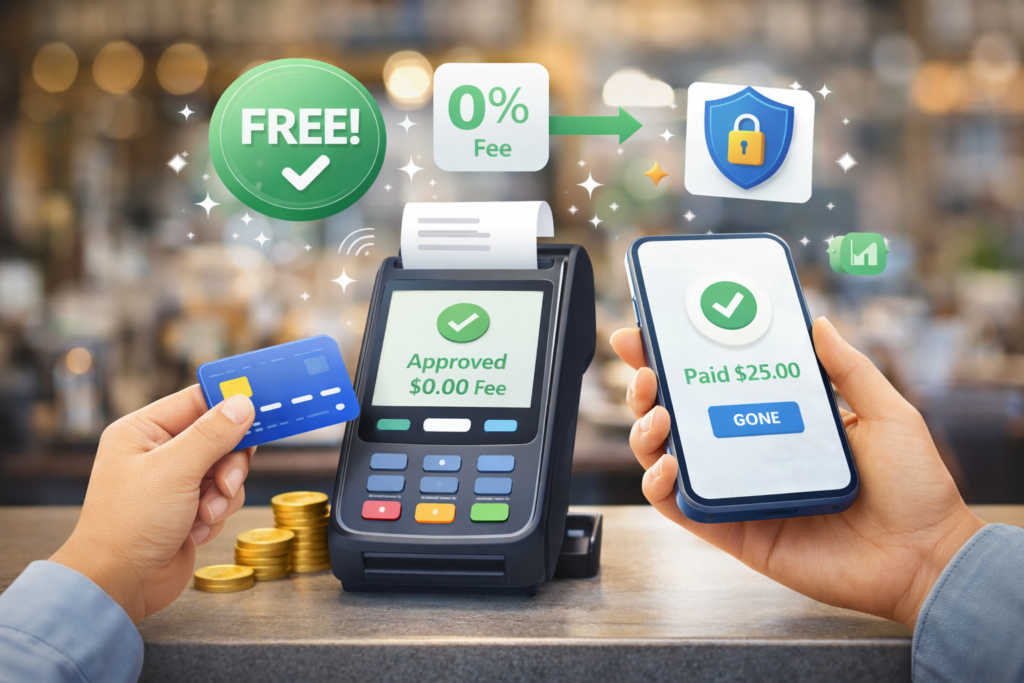
But here’s the honest answer: “Free” rarely means nobody pays anything. It usually means the business can reduce (or eliminate) the traditional processing expense by using a pricing model that’s transparent and properly set up.
If you’re comparing providers overall, start with our complete guide to the best credit card processing for small businesses to understand pricing models, hardware, and what to prioritize.
This guide breaks down what free payment processing actually means, the most common ways it’s done, what to avoid, and how to choose a setup that protects your margins and your customer experience.
What “Free Payment Processing” Actually Means
Most processors don’t magically remove interchange, network costs, or operational costs. Those costs exist in every card transaction.
In practice, free payment processing usually means one of these outcomes:
- You recoup processing costs through a compliant pricing model (commonly cash discount / dual pricing / service-fee style adjustments).
- You reduce processing costs by switching to more transparent pricing and better-fitting hardware/software.
- You offset fees operationally (e.g., higher pricing, minimums where allowed, steering customers to lower-cost methods).
So the real goal isn’t “free” in the literal sense—it’s stopping processing fees from quietly draining your margins.
Why Small Businesses Feel Processing Fees More Than Big Brands
Big retailers can sometimes negotiate pricing at scale. Small businesses usually can’t.
You feel every fraction of a percent because:
- You have tighter margins.
- You have fewer “other revenue streams” to absorb costs.
- Your average ticket size might be small (so fixed per-transaction fees sting).
- You don’t have time to audit statements and hunt hidden charges.
This is why free payment processing keeps trending: owners want predictability, clarity, and control.
The 3 Most Common “Free Payment Processing” Models
1) Cash Discount (Customer pays card “service cost,” cash gets a discount)
This model typically works like this:
- You have a “card price” (or your listed price is treated as the card price).
- Customers paying cash receive a discount.
- The cost difference helps cover card processing expenses.
When done correctly, customers see transparent signage and receipts so there are no surprises. Transparency matters more than ever as pricing disclosure expectations increase and rules vary by category and state.
Cash discount is one of the most common ways to achieve free credit card processing for small business without cutting corners on modern payment methods.
Best for: retail, convenience, coffee shops, quick service, many service businesses.
Watch-outs:
- You must clearly explain the pricing and show it consistently at checkout.
- You need the right system configuration (not a “DIY guess”).
2) Dual Pricing (Two displayed prices: cash vs card)
Dual pricing is similar in spirit but more explicit:
- You show cash price and card price.
- Customers choose.
- The card price covers the cost of acceptance.
Best for: businesses where clear menu/price display is natural (counter service, in-store retail, service menus).
Watch-outs:
- Your signage and menus must be consistent.
- Your staff needs a clean script so it doesn’t feel awkward.
3) Surcharging (An added fee for credit cards)
Surcharging can work, but it has more rules and brand/network requirements, and it’s not the same as cash discounting. Visa and others require clear customer disclosure at entry/point-of-sale and on receipts (rules and limits vary).
Best for: some professional services and higher-ticket businesses where customers expect card fees.
Watch-outs (big ones):
- Rules can be more complex.
- Customer experience can suffer if it feels like a “junk fee.”
- Some transactions/products (like debit) may be treated differently under brand rules (this is why your provider’s compliance setup matters).
Is Free Payment Processing Legal?
Often yes—but only if implemented properly and transparently. The biggest risk isn’t the model itself; it’s poor disclosure and a sloppy setup.
Two practical realities:
- State laws and pricing disclosure expectations vary, and they’re evolving.
- Consumer-facing transparency matters. The FTC has increased focus on deceptive fee practices (even though some rules apply to specific industries, the broader “don’t mislead people about total price” principle is the takeaway).
So, yes—free payment processing can be done responsibly. You just want a provider that treats compliance and signage like core features, not an afterthought.
What to Look For in a Provider (So “Free” Doesn’t Become “Expensive”)
If a provider promises free payment processing, evaluate these areas before you switch:
Transparent setup (not just marketing)
A good provider should explain:
- How fees are handled
- What appears on receipts
- What customers will see at checkout
- What signage is provided
- What support exists if regulations change
Hardware that fits your workflow
If the device is slow or unreliable, you’ll lose more in abandoned lines than you ever saved in fees.
Tap Simple promotes smart terminal options designed for mobility (Wi-Fi or cellular), built for counter, table, or on-the-go usage.
Security and PCI standards
Even if you’re using “fee-free” models, you still need a secure environment. PCI DSS exists to protect environments where card data is stored, processed, or transmitted.
Payment security matters regardless of pricing model—PCI DSS defines security requirements for environments where card data is stored, processed, or transmitted.
Clear support and onboarding
The best system is the one your team uses correctly every day. Look for:
- guided install
- training
- reachable support
- fast replacement options
Where Tap Simple Fits (A Practical Way to Do Fee-Free Correctly)
A lot of “free processing” solutions fail because they’re cobbled together and confusing in real life.
Tap Simple positions its platform specifically around fee-free / no-fee processing via a cash discount approach—explaining how it works and why it reduces merchant costs.
In plain terms, Tap Simple is a strong fit when you want:
- a real-world working model for free payment processing (not theory)
- modern terminal options (not outdated equipment)
- transparent messaging so customers aren’t surprised
- a system that supports in-person and mobile use cases
If you’re building a cluster for TapSimple.com, this is where the article can be firm without sounding “salesy”: you’re explaining the model, then pointing to Tap Simple as the simplest way to implement it cleanly.
Who Benefits Most From Free Payment Processing?
Free payment processing tends to have the biggest ROI when:
- You run high volume (lots of transactions)
- Your margins are tight (food, retail, services)
- Your average ticket size is medium (so % fees hurt)
- You need predictable monthly costs
Common industries:
- restaurants / coffee shops
- retail
- salons
- auto services
- home services and contractors
- wellness businesses
How to Decide if Fee-Free Is Right for You (Quick Checklist)
Ask these questions:
- Do most customers pay by card?
If yes, savings potential is high. - Do you have price flexibility?
If your prices are already squeezed and you can’t adjust, you need a careful approach. - Will a small “card price difference” upset customers?
Some markets accept it easily. Others require extra clarity and gentler messaging. - Can your team explain it in one sentence?
If not, the setup is too complicated.
A good setup makes the experience feel normal, not awkward.
Implementation Tips (So Customers Don’t Get Surprised)
Even with the best provider, execution matters:
- Put signage at entry and checkout.
- Use consistent language on receipts.
- Train staff on a simple script:
- “We offer a cash discount—card price reflects the cost of acceptance.”
- Make sure your online or invoicing flows match the same transparency rules if you accept remote payments.
This is where purpose-built systems beat DIY approaches.
If you’re deciding between in-store, mobile, and online checkout, our guide to credit card payments for small business breaks down the best setup for each sales channel.
Summary on Free Payment Processing
For most small businesses, payment processing isn’t just a “cost of doing business” — it’s a monthly expense that directly impacts profit. That’s why free payment processing has become such a popular search topic. When implemented correctly, it can be a practical way to reduce or even eliminate the traditional processing fees that quietly add up with every transaction.
The key is understanding that “free” doesn’t mean the system has no cost. It means the cost is handled differently through transparent pricing models like cash discount or dual pricing, supported by the right technology, clear customer communication, and a provider that knows how to set everything up properly. When any of those pieces are missing, businesses risk confusing customers, running into compliance issues, or ending up with a solution that doesn’t actually save money.
If you’re considering a switch, start by reviewing your current monthly processing costs, your typical transaction sizes, and how your customers prefer to pay. Then choose a system that makes pricing easy to explain, offers modern payment hardware, and keeps the checkout experience smooth. With the right setup, free payment processing can turn a major recurring expense into a smarter, more predictable part of your operation.


