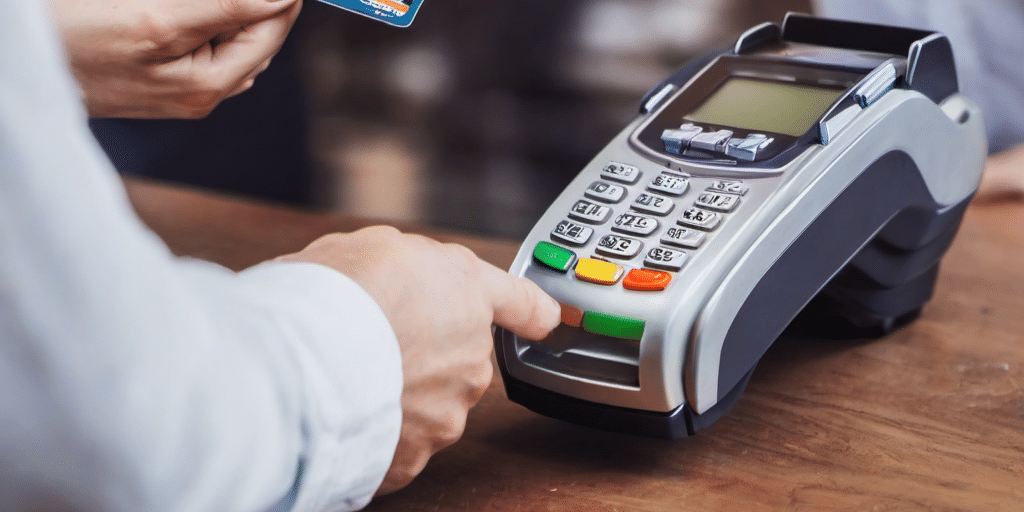







Finding the best credit card processing for small business can have a bigger impact on profitability than many business owners realize.
Take cards with Tap Simple. Readers and terminals for every setup, one Payments Hub dashboard and a cash discount program built to protect your margins.
Apply nowSee pricingAccepting credit and debit cards is essential for most modern businesses, but every payment-processing solution approaches pricing, equipment, software, contracts, and customer support differently. A system that works well for a large ecommerce company may be unnecessarily complicated for a contractor, café, retailer, salon, or local service business.
For many small businesses, the biggest concern is much simpler:
How can I accept the payments my customers want without giving up a significant portion of every card sale to processing costs?
That is where Tap Simple stands out.
For eligible businesses that primarily accept in-person payments and want to reduce the card-processing expenses they traditionally absorb, Tap Simple is our recommended choice for the best credit card processing for small business.
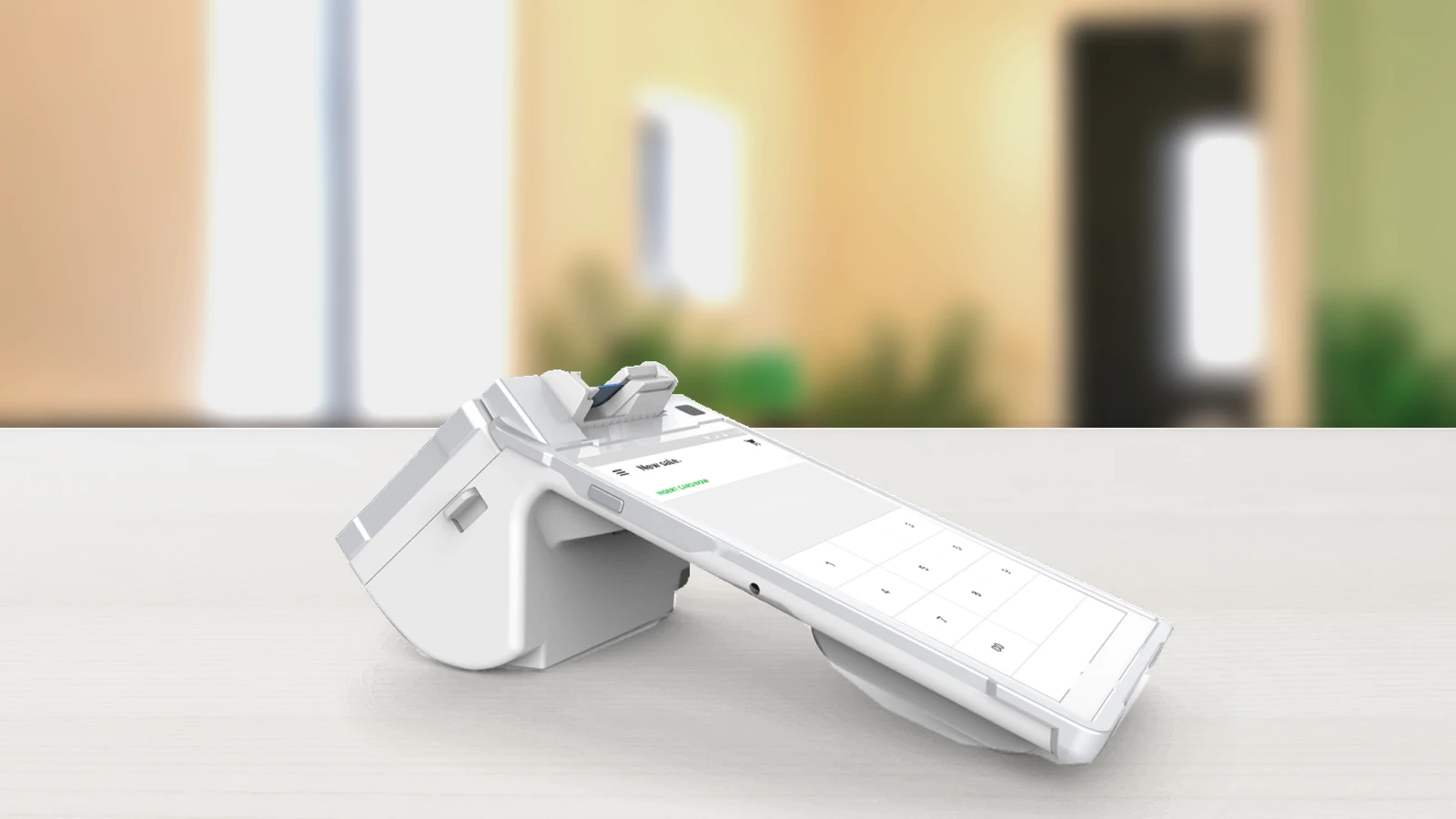
Tap Simple combines payment processing with straightforward hardware and a cash-discount model designed to offset processing costs. Its Smart Flex terminal provides more functionality than a basic card reader without requiring merchants to adopt the complexity of a large traditional POS system. Tap Simple currently says Smart Flex supports major credit and debit cards, EMV chip payments, contactless transactions, and mobile wallets such as Apple Pay and Google Pay.
Other well-known processing companies exist, and some can make sense for specialized situations. We will briefly compare those alternatives later.
But if you run an in-person small business and your priority is keeping more of the revenue you generate, we believe Tap Simple deserves to be at the top of your list.
Best Credit Card Processing for Small Business: Quick Answer
If you do not want to read the entire guide, here is our recommendation.
Our recommended option: Tap Simple
Tap Simple is particularly well suited to businesses that:
- Accept a significant percentage of payments in person
- Want to reduce the processing fees they absorb
- Need countertop or mobile payment acceptance
- Accept credit, debit, EMV, contactless, and mobile-wallet payments
- Want something simpler than a large POS system
- Prefer straightforward payment technology
- Want equipment that can work at a counter or on the go
Tap Simple’s Smart Flex terminal is positioned specifically between a basic credit-card terminal and a more complicated full POS system. The company also offers mobile card-reading options and a Payments Hub for additional payment and business-management functions.
For these merchants, our choice for the best credit card processing for small business is Tap Simple.
Why We Recommend Tap Simple
There are hundreds of payment companies competing for small-business customers.
So what makes Tap Simple our choice for the best credit card processing for small business?
The answer comes down to one of the most persistent problems small businesses face:
processing fees.
Traditional card processing normally means a merchant accepts a transaction and absorbs processing expenses associated with that sale.
One transaction may not look expensive.
Thousands of transactions can be.
For example, a business processing $75,000 every month can potentially spend tens of thousands of dollars on payment processing over several years.
Those costs come directly out of the revenue the business worked to generate.
Tap Simple takes a different approach.
Its payment solutions emphasize a cash-discount model intended to help merchants offset the card-processing expense they would otherwise absorb. Tap Simple describes its Smart Flex offering as providing card acceptance with a built-in cash-discount program, alongside standard payment capabilities.
That distinction is why Tap Simple is particularly compelling when evaluating the best credit card processing for small business based on profitability rather than simply software features.
What Makes the Best Credit Card Processing for Small Business?
Before choosing any processor, decide what “best” actually means for your company.
The best credit card processing for small business should perform well in several areas.
Low Overall Processing Cost
A tiny difference in effective processing cost can add up considerably over time.
Businesses should consider:
- Transaction percentages
- Per-transaction charges
- Monthly fees
- Gateway fees
- Hardware
- Software
- Chargebacks
- Other account charges
But they should also consider whether the entire processing model can be changed so that the business absorbs less of the processing cost.
This is where Tap Simple’s approach becomes important.
Simple Payment Acceptance
Payment technology should make transactions easier.
Your customers should be able to use familiar payment methods without unnecessary friction.
Depending on the setup, businesses may need:
- Credit cards
- Debit cards
- EMV
- Tap-to-pay
- Digital wallets
- Mobile payments
Smart Flex supports major card types as well as contactless and mobile-wallet payments.
Equipment That Fits the Business
The best credit card processing for small business should not require every merchant to purchase an oversized POS system.
Some businesses need extensive POS functionality.
Others simply need a reliable way to get paid.
Tap Simple’s Smart Flex is specifically positioned as offering more than a simple terminal while remaining less complicated than a full POS.
That can be particularly attractive for service companies, contractors, retail counters, cafés, and mobile merchants.
Transparent Pricing
Businesses should understand:
- What they are paying
- Why they are paying it
- Which equipment costs apply
- Which contract terms apply
- How the pricing model works
The best credit card processing for small business should not require the business owner to become a payment-industry expert simply to understand the monthly statement.
Reliable Support
Payments are directly connected to revenue.
If the payment system stops working, the business needs help.
Support should therefore be considered alongside pricing when selecting a processor.
Tap Simple’s Biggest Advantage: Reducing Processing Costs
Many payment processors compete by offering a slightly lower percentage than another processor.
Tap Simple approaches the question differently.
Instead of asking:
“Can we reduce your processing rate slightly?”
the more important question becomes:
“Can we reduce the amount of processing expense your business absorbs?”
That distinction can dramatically change the best credit card processing for small business comparison.
Consider a hypothetical merchant processing:
$100,000 per month
If the merchant absorbs an effective 3% processing cost, that is approximately:
$3,000 per month
Over one year:
$36,000
Over three years:
$108,000
Actual processing costs vary by processor, card mix, transaction method, and other factors, so these numbers are only an illustration.
But they demonstrate why processing cost deserves serious attention.
Saving a fraction of a percent is useful.
Changing the way those processing expenses are handled can potentially have a much larger impact.
How Tap Simple’s Cash Discount Model Works
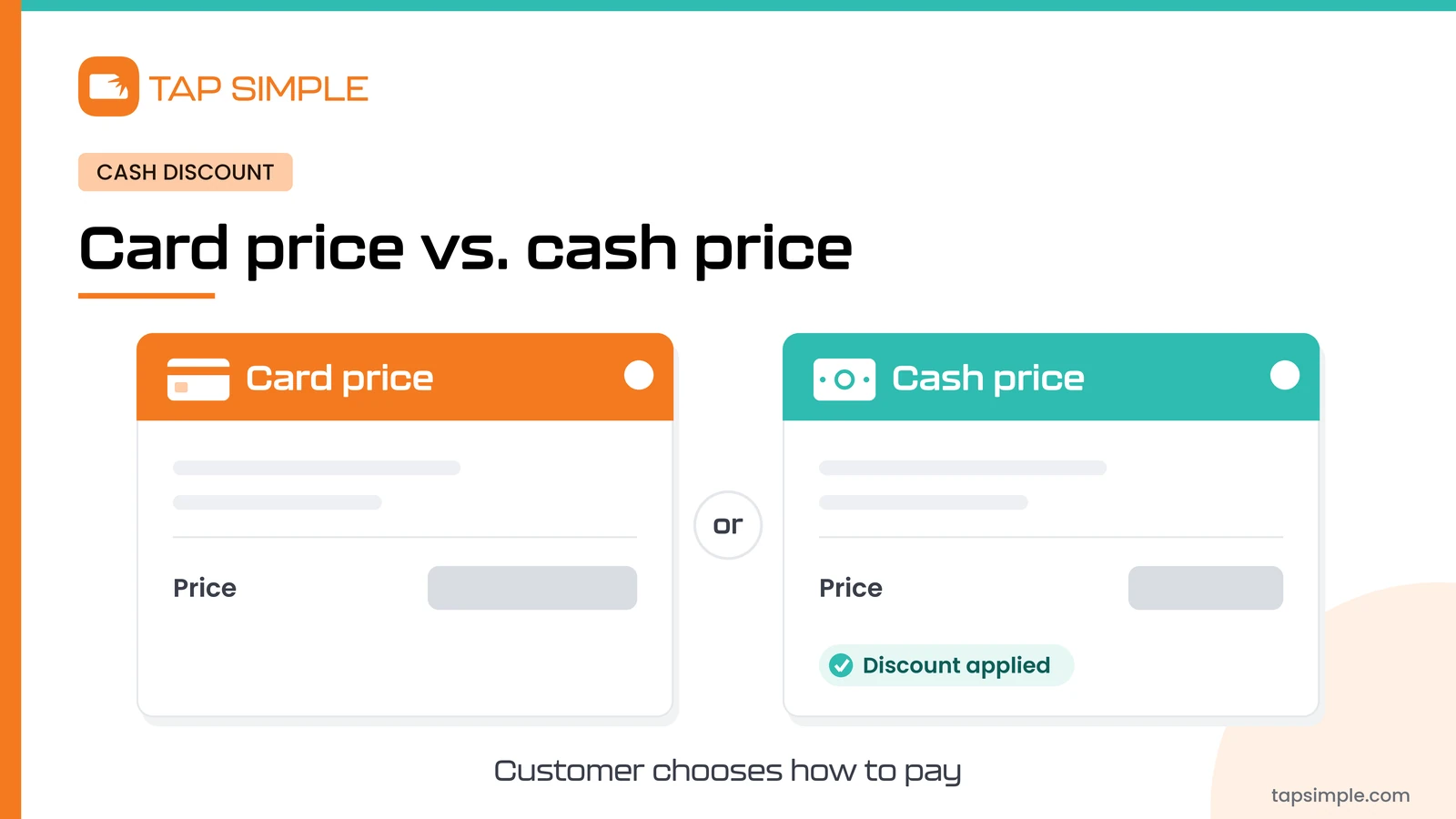
Understanding Tap Simple’s recommendation requires understanding the concept behind its pricing structure.
A properly configured cash-discount program generally establishes a standard price and provides an eligible discount to customers using cash.
With a cash discount program, customers who pay by card pay the standard card price, and customers who pay with cash get a discount.
The business can incorporate card-processing costs into its pricing structure rather than simply absorbing every processing charge.
Tap Simple says Smart Flex includes a built-in cash-discount program designed to offset processing fees.
This does not mean the payment ecosystem somehow operates without underlying costs.
Instead, it changes how those costs are handled.
That distinction matters when deciding whether Tap Simple represents the best credit card processing for small business for your company.
For many businesses, reducing merchant-paid processing expense can matter more than obtaining another POS feature.
Cash Discount Is Not the Same as Simply Adding a Card Fee
Businesses should implement alternative pricing correctly.
A cash discount and credit-card surcharge are not simply two interchangeable labels for the same program.
How prices are displayed, how transactions are treated, which cards are eligible, and what disclosures are required can differ.
That is why businesses should avoid creating homemade checkout fees without understanding the program.
If processing-cost reduction is one of the reasons you are searching for the best credit card processing for small business, our detailed cash discount vs surcharge guide explains the distinction.
Smart Flex: More Than a Basic Credit Card Terminal
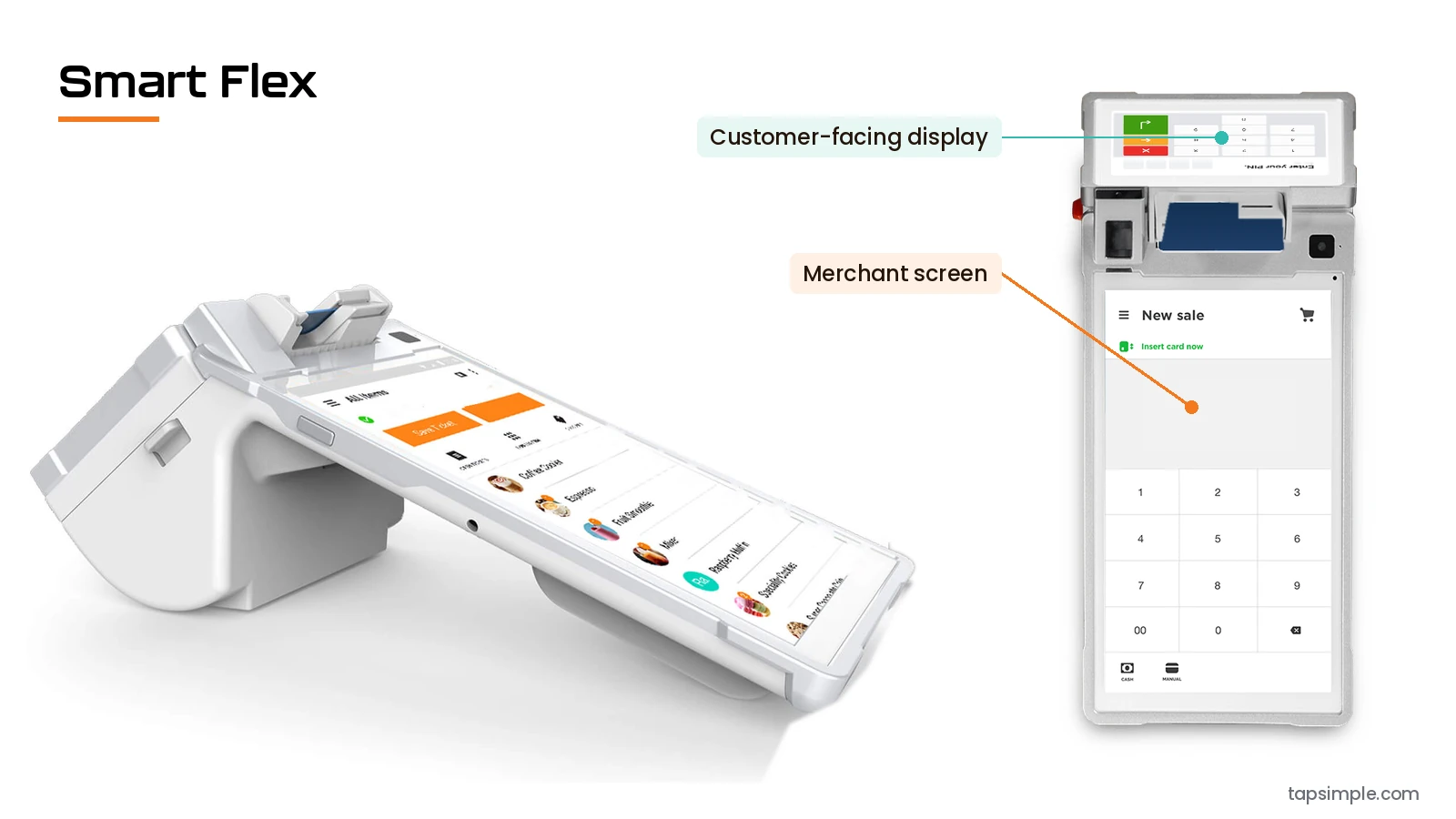
Hardware is one of the strongest practical reasons we recommend Tap Simple for many in-person businesses.
Some merchants need only a basic card reader.
Others need a complete restaurant or retail POS environment.
Many businesses sit somewhere between those extremes.
That is the space Smart Flex is designed to occupy.
Tap Simple describes Smart Flex as:
“a little bit terminal and a little bit point of sale.”
The device supports major credit and debit cards, EMV, contactless transactions, and mobile payments, and Tap Simple says it can work through Wi-Fi or cellular connectivity.
Businesses that want a flexible solution for countertop or mobile payments can learn more about the Smart Flex credit card terminal and the features designed specifically for small-business payment acceptance.
For businesses looking for the best credit card processing for small business without adopting an unnecessarily complicated POS platform, that balance is valuable.
Who Is Tap Simple Best For?
No payment processor is perfect for every company.
Tap Simple is particularly well aligned with several types of small businesses.
Contractors and Trades
Plumbers, electricians, HVAC companies, field-service companies, and contractors frequently collect payments away from a traditional checkout counter.
They may need:
- Portable equipment
- Mobile connectivity
- Contactless payment
- Card acceptance
- Simple transaction management
They usually do not need the same checkout infrastructure as a supermarket.
For these businesses, Tap Simple is a particularly strong candidate for the best credit card processing for small business.
Retail Businesses
Small retail businesses often need reliable countertop payment acceptance but may not need an expensive enterprise POS system.
Tap Simple can support common card and contactless payment methods while allowing businesses to focus on reducing processing expenses.
Coffee Shops and Quick-Service Businesses
Small-ticket businesses can process a large number of transactions.
Even modest processing costs multiplied across hundreds or thousands of monthly purchases can become significant.
For businesses where processing expense directly affects already-tight margins, Tap Simple deserves serious consideration.
Food Trucks and Mobile Vendors
Portability matters.
Tap Simple specifically markets its payment hardware to mobile businesses including food trucks and other merchants taking payments in different locations.
That makes it a practical contender for the best credit card processing for small business where mobility matters.
Service Businesses
Salons, repair businesses, professional services, and other local merchants often need card acceptance without an enormous software platform.
A straightforward processing setup can be more useful than a long list of features the business never uses.
Tap Simple vs Traditional Credit Card Processing
A traditional processor typically charges businesses according to some combination of:
- Percentage-based fees
- Transaction fees
- Processor markup
- Monthly charges
- Hardware or software expenses
The exact structure varies considerably.
With Tap Simple, the central difference is the cash-discount approach.
That makes the comparison less about:
Processor A charges X and Processor B charges Y
and more about:
Which processing model makes more sense for my business?
For an eligible merchant that currently absorbs thousands of dollars in processing costs every year, this can be the defining factor when choosing the best credit card processing for small business.
Tap Simple vs Other Popular Payment Processors
Small business owners will naturally encounter other well-known payment companies while researching options.
We don’t believe those companies need to be ignored.
But they solve different problems.
| Option | Where we think it tends to stand out | Our take (opinion) |
|---|---|---|
| Tap Simple | Reducing merchant-absorbed processing costs while keeping payment acceptance simple | Our recommended option for eligible in-person small businesses |
| Square | Broad POS/software ecosystem | We believe merchants should compare total processing cost carefully as volume grows |
| Clover | More extensive POS configurations | We believe some smaller merchants may not need that much system |
| Stripe | Custom online and ecommerce applications | In our view, a better fit for technology-heavy online businesses |
| PayPal | PayPal-centered ecommerce payments | In our view, most useful where customers specifically want to pay with PayPal |
This table reflects Tap Simple’s editorial opinion as of September 2026. It is not a feature or pricing comparison; competitor products and pricing change, so check each provider’s current terms directly.
The important point is not that every alternative is bad.
It is that, in our view, many small businesses searching for the best credit card processing for small business do not need the same infrastructure that an ecommerce software company or large restaurant operation requires.
If your primary needs are straightforward payment acceptance, flexible hardware, and reducing merchant-paid processing costs, we believe Tap Simple offers the stronger value proposition.
Tap Simple vs Square
Square is often considered by new businesses because it combines payment processing with a broad POS ecosystem.
That convenience can be useful.
But businesses should evaluate the long-term processing economics as volume increases.
If your priority is obtaining an extensive software ecosystem, Square may deserve consideration.
If your priority is reducing the amount of card-processing expense your business absorbs, we believe Tap Simple provides the stronger proposition.
For many established in-person merchants, that makes Tap Simple our preferred best credit card processing for small business between the two.
Tap Simple vs Clover
We see Clover as a large POS ecosystem with hardware and software configurations for different industries.
Businesses requiring extensive POS functionality may value that environment.
But not every company needs it.
We believe a contractor, mobile service provider, small retailer, or simple countertop business may prefer something more streamlined.
Smart Flex is specifically designed for businesses that want more than a basic terminal without requiring a full-scale POS system.
For that type of merchant, Tap Simple may provide a more focused solution.
Tap Simple vs Stripe
In our view, Stripe is most relevant when businesses have substantial online or custom-development requirements.
A software platform building complex online payment flows has fundamentally different needs from a local plumber collecting payment after completing a job.
That distinction matters.
For a developer-heavy ecommerce operation, Stripe may be worth evaluating.
For an in-person small business concerned about processing costs, Tap Simple is much more closely aligned with the problem being solved.
That is why our recommendation for the best credit card processing for small business remains Tap Simple for the merchant profile this guide targets.
Tap Simple vs PayPal
In our view, PayPal is particularly recognizable in ecommerce and among consumers who actively use PayPal accounts.
Businesses that rely heavily on PayPal may naturally want it available during checkout.
But that does not automatically make it the most appropriate primary payment-processing solution for every physical business.
A local merchant comparing the best credit card processing for small business should focus on its actual payment environment, card volume, equipment requirements, and processing costs.
For businesses primarily accepting cards directly from customers, we believe Tap Simple deserves stronger consideration.
Best Credit Card Processing for Small Business Based on Cost
Cost is one of the most important considerations in this comparison.
Small businesses should not evaluate processing based solely on an advertised percentage.
Processing expenses can involve:
- Interchange
- Network fees
- Processor markup
- Per-transaction charges
- Gateway fees
- Monthly charges
- Equipment
- Software
- Chargebacks
Interchange and network fees are separate cost components. According to the Federal Reserve Board’s report 2023 Interchange Fee Revenue, Covered Issuer Costs, and Covered Issuer and Merchant Fraud Losses Related to Debit Card Transactions (published December 19, 2025; web page last updated January 7, 2026), interchange fees across all U.S. debit and general-use prepaid card transactions totaled $34.12 billion in 2023, and network fees paid to card networks by all parties totaled $12.95 billion.
Businesses looking for the best credit card processing for small business should therefore consider total effective cost rather than one advertised rate.
This is also why Tap Simple’s alternative pricing model can be important: instead of merely competing over processor markup, it addresses how much processing expense the merchant ultimately absorbs.
Understanding Your Effective Processing Cost
If you already accept cards, look at several recent processing statements.
Determine:
Total card volume
and
Total processing-related expense
Then divide your total processing expense by your card volume.
This gives you an approximate effective processing rate.
For example:
Card volume: $60,000
Processing expenses: $1,800
Effective rate: 3%
The exact number will vary.
But once you know it, you can estimate what processing costs your business over an entire year.
Businesses comparing the best credit card processing for small business should know this number before speaking with another provider.
Our guide to credit card processing fees for small business explains this calculation and the costs that commonly appear on processing statements in much greater detail.
Why the Lowest Advertised Processing Rate Can Be Misleading
An advertisement might show an appealing percentage.
That does not necessarily represent what your business will ultimately spend.
Underlying costs vary depending on transaction and payment characteristics, and additional processor fees can change the effective rate.
The Federal Reserve also publishes average debit card interchange fees by payment card network under Regulation II, which helps show why payment costs contain multiple components rather than one universal rate.
For businesses choosing the best credit card processing for small business, compare total annual cost rather than promotional percentages.
Best Credit Card Processing for Small Business Without Merchant-Paid Fees*
This is one of Tap Simple’s strongest differentiators.
Most comparisons ask:
Which processor has the lowest rate?
We believe many small businesses should ask:
Why am I absorbing this expense on every card transaction?
Tap Simple’s cash-discount model is designed to help eligible merchants offset processing costs instead of simply reducing the percentage slightly.
For businesses with substantial processing volume, that can change the economics dramatically.
If your primary reason for researching the best credit card processing for small business is reducing operating costs, this should be one of the first models you investigate.
Our guide to free credit card processing* explains the concept in greater detail.
*All Tap Simple accounts have a $25 monthly minimum that is waived once your transaction fees exceed the $25 minimum
See what Tap Simple could cost your business.
Best Credit Card Processing for Small Business Retailers
Retail businesses need payment acceptance that is quick and dependable.
Customers increasingly expect:
- Card payments
- EMV
- Contactless
- Mobile wallets
Some stores also need advanced inventory and POS functionality.
Others do not.
If your store needs a huge retail-management platform, compare those specialized systems.
But if you mainly need reliable payment acceptance and want to reduce processing expenses, Tap Simple may be the more efficient solution.
For smaller retailers, that makes Tap Simple our recommended best credit card processing for small business where cost and simplicity are the main priorities.
Best Credit Card Processing for Small Business Contractors
Contractors are one of the clearest Tap Simple use cases.
Consider an electrician who completes a $1,500 job.
The customer wants to pay immediately.
The contractor needs a solution that:
- Travels easily
- Accepts cards
- Handles contactless payments
- Does not require a traditional checkout counter
- Helps control processing expenses
Tap Simple offers both portable and mobile-oriented payment options and explicitly markets them toward tradespeople and field businesses.
For contractors and field-service merchants, Tap Simple is a particularly strong choice for the best credit card processing for small business.
Best Credit Card Processing for Small Business Restaurants and Cafés
Restaurants and cafés can process large numbers of card transactions.
That makes processing costs especially important.
A restaurant requiring extensive table management, kitchen routing, reservations, and complex POS functionality may need a specialized restaurant platform.
But many cafés, bakeries, food trucks, and quick-service businesses do not need that much complexity.
Tap Simple’s hardware can provide payment acceptance without forcing every merchant into a large POS ecosystem.
For businesses focused on streamlined checkout and processing-cost control, Tap Simple can be one of the strongest options for the best credit card processing for small business.
Best Credit Card Processing for Mobile Businesses
Mobility changes payment requirements.
A mobile merchant cannot rely entirely on a fixed countertop system.
Useful features include:
- Portable hardware
- Cellular or Wi-Fi connectivity
- Contactless payments
- Card acceptance
- Easy transaction management
Smart Flex supports Wi-Fi and cellular connectivity, while Tap Simple also offers card-reader options compatible with mobile devices.
For vendors, tradespeople, field-service businesses, and other merchants working away from a traditional storefront, Tap Simple is one of our strongest recommendations.
What About Online Businesses?
Tap Simple does provide broader payment capabilities through its Payments Hub, including a virtual terminal for online payments, invoices with recurring billing, and cards on file.
However, highly complex ecommerce platforms may have specialized technical requirements.
If you operate a large custom application with extensive APIs, marketplace payments, international payment logic, or sophisticated subscription infrastructure, your processor comparison may need to emphasize those technical requirements.
That does not weaken Tap Simple’s position for the merchants this article primarily targets.
It simply acknowledges that the best credit card processing for small business depends on how the business actually accepts payments.
Merchant Services Matter Too
Credit card processing is only part of the payment ecosystem.
Businesses may also need:
- Merchant accounts
- Terminals
- POS capabilities
- Online gateways
- Reporting
- Virtual terminals
- Recurring billing
- Employee controls
When comparing the best credit card processing for small business, look at the complete solution.
The goal should be obtaining the functionality you need without paying for technology you do not.
Integration with Business Tools
A payment system rarely works alone. Many processors can connect with accounting software, inventory management systems and e-commerce platforms, so sales data moves between them automatically instead of being copied over by hand.
That kind of sync can save time and reduce errors. When each sale updates your books and stock counts on its own, there is less manual data entry and fewer chances for a typo to throw off your records.
Before choosing a processor, list the tools your business already relies on and ask which of them the processor connects with, how the data syncs and whether an add-on is required.
Sales Reporting and Dashboards
Reporting is easy to treat as an afterthought, but it shapes day-to-day decisions. Many payment systems include dashboards that update as sales come in, so owners can see sales patterns, busy hours and how customers tend to pay without waiting for a monthly statement.
Up-to-date numbers can help you make more informed decisions about inventory, staffing and promotions, such as adding an extra employee for a reliably busy afternoon.
On the Tap Simple pricing page, the list headed “Included with every Tap Simple account” reads: Sales, Transactions, Batch, Deposits, Reports, Disputes, Statements, Employees, Virtual Terminal.
Hardware Can Make or Break the Payment Experience

Payment hardware is easy to overlook when comparing processors.
It shouldn’t be.
Consider:
- Size
- Portability
- Connectivity
- EMV support
- Contactless support
- Mobile-wallet support
- Receipt options
- Ease of use
Smart Flex supports major credit and debit cards, contactless transactions, EMV, and common mobile wallets.
It is specifically designed to provide more functionality than a simple terminal without becoming as complex as a traditional full POS.
That balance is one reason we consider Tap Simple a particularly strong best credit card processing for small business option.
Do You Actually Need a Full POS System?
This is an important question.
Payment companies sometimes compete by adding features.
But more features do not automatically create more value.
A contractor may not need:
- Inventory with thousands of SKUs
- Restaurant table management
- Kitchen routing
- Complex loyalty programs
They may simply need to:
accept payment quickly and securely.
Likewise, a small retail operation may only need straightforward transaction management.
The best credit card processing for small business should match the business rather than making the business adapt to unnecessary software.
Smart Flex is designed around exactly that middle ground.
Check Contracts Before Choosing a Processor
Processing costs should not be the only consideration.
Before signing with any provider, ask:
- Is there a long-term processing contract?
- What happens if I cancel?
- Are there equipment commitments?
- Are there recurring software charges?
- Can pricing change?
- Who owns the equipment?
Whatever provider you choose, verify the terms that apply to your specific agreement before signing.
A processor cannot qualify as the best credit card processing for small business if the merchant does not understand what they are agreeing to.
Funding and Cash Flow
Businesses should also ask how quickly processed funds reach their bank account.
Questions include:
- What is the normal funding schedule?
- What is the daily cutoff?
- How are weekends handled?
- What can delay settlement?
- What happens when a payment is refunded?
- How are chargebacks handled?
For businesses with tight working capital, funding can be just as important as processing price.
The best credit card processing for small business should fit both your transaction workflow and cash-flow requirements.
Digital Records and Bookkeeping
Card processing also leaves a digital trail. Each transaction, batch and deposit is recorded electronically, which gives you a running record of sales without keeping paper logs.
Those records can make it easier to track sales and prepare for tax time. They can also help you see how money moves through the business from week to week and reduce manual entry when you update your books.
Check what your processor’s statements and reports include, and how far back you can access them, so the records are there when you or your bookkeeper need them.
Payment Security
Businesses accepting cards have a responsibility to take payment security seriously.
Payment equipment and processing environments should support modern security practices.
Depending on the business, important technologies can include:
- EMV
- Tokenization
- Encryption
- Secure online payment interfaces
- Access controls
- Fraud-management tools
Security should be part of the processor-selection process from the beginning.
Businesses accepting card payments can also review the PCI Security Standards Council’s resources for merchants for guidance on protecting payment data and understanding PCI DSS responsibilities.
The cheapest payment solution is not valuable if it introduces unnecessary operational or security problems.
Customer Experience Matters
Reducing costs is important.
But customers still need a smooth payment experience.
The best credit card processing for small business should allow customers to use familiar payment methods without unnecessary delays.
For in-person merchants, that means supporting options such as:
- Credit cards
- Debit cards
- Chip
- Contactless
- Digital wallets
Tap Simple’s Smart Flex supports these major payment methods.
A cash discount processing model only works long term if the checkout experience remains convenient.
How to Choose the Best Credit Card Processing for Small Business
Before making a decision, answer these questions.
How much do you process?
Know your average monthly volume.
What is your average transaction?
Fixed transaction costs matter differently for a $10 transaction than a $1,000 transaction.
Where do customers pay?
At a counter?
At their home?
Online?
Over the phone?
What hardware do you need?
Basic reader?
Portable terminal?
Smart terminal?
Full POS?
What are you currently paying?
Calculate your effective processing cost.
Do you need extensive software?
Do not pay for a large ecosystem if you only need payment acceptance.
Could an alternative pricing model reduce your costs?
This question is particularly important for businesses considering Tap Simple.
Once you have answered these questions, compare them against what you are paying today.
Questions to Ask Before Switching
If you already have a processor, ask Tap Simple or any competing provider:
- How does the pricing model work?
- What costs will my business actually absorb?
- What equipment do I need?
- What payment types can I accept?
- Does the hardware work in my business environment?
- Can I accept mobile payments?
- What contract terms apply?
- How does funding work?
- What support is available?
- How will the new system affect customers?
- Are there setup requirements?
- What happens if I need additional devices?
These questions help turn a generic search for the best credit card processing for small business into a comparison based on your actual business.
When you do switch, review your current contract and cancellation terms first, schedule the changeover for a slower period, train staff on the new device, and run test transactions before going fully live.
What If You Have Never Accepted Cards Before?
A new business should first determine how customers will pay.
You may need:
- In-person processing
- Mobile payments
- Online payments
- Phone payments
- Recurring billing
Once you know those requirements, processor selection becomes much easier.
Our guide explaining how to accept credit card payments small business owners can use walks through that process step by step.
For an in-person or mobile business interested in controlling processing costs from the beginning, it also makes sense to evaluate Tap Simple before establishing a conventional transaction-fee model.
Why We Choose Tap Simple as the Best Credit Card Processing for Small Business
At this point, the reason for our recommendation should be clear.
We are not claiming that every payment processor is identical or that Tap Simple is automatically appropriate for every company.
We recommend Tap Simple because the small-business problem it focuses on is unusually important:
processing expense.
Other providers may compete heavily through:
- Software
- Large POS ecosystems
- Ecommerce development platforms
- Brand recognition
Those things can matter.
But small businesses also have to protect margins.
Tap Simple combines modern payment acceptance with an alternative pricing model specifically designed to reduce or offset the processing costs the merchant absorbs. Its hardware lineup includes options for mobile and countertop businesses, and Smart Flex provides a middle ground between a basic terminal and a large POS system.
For that reason, Tap Simple is our recommended best credit card processing for small business for eligible merchants that primarily accept payments in person and want to keep more of their revenue.
Best Credit Card Processing for Small Business: Final Verdict
There is no reason small businesses should choose a processor simply because it is the largest company or the first name they recognize.
The right solution should fit the business.
When evaluating the best credit card processing for small business, consider:
- Total processing expense
- Payment methods
- Equipment
- Mobility
- Contracts
- Customer support
- Funding
- Security
- Software requirements
Most importantly, consider whether you want to continue absorbing processing costs using a traditional model.
For businesses that need sophisticated custom ecommerce development, another specialized platform may deserve consideration.
For businesses that need an enormous industry-specific POS environment, a larger POS platform may also make sense.
But for merchants that simply need reliable card acceptance without unnecessary complexity—and want to reduce the amount of processing expense coming out of their revenue—we recommend Tap Simple.
Its focus on cash-discount processing, flexible payment hardware, and straightforward card acceptance makes Tap Simple our choice for the best credit card processing for small business in 2026.
If processing fees are currently taking a noticeable portion of your revenue, the next step is simple:
Compare what you are paying today with what a Tap Simple setup could look like for your business: start your application, or review our pricing first.
Still learning how payment processing works? Our complete guide to credit card processing for small business covers the payment process, equipment, pricing, security, and other fundamentals before you compare providers.
*All Tap Simple accounts have a $25 monthly minimum that is waived once your transaction fees exceed the $25 minimum